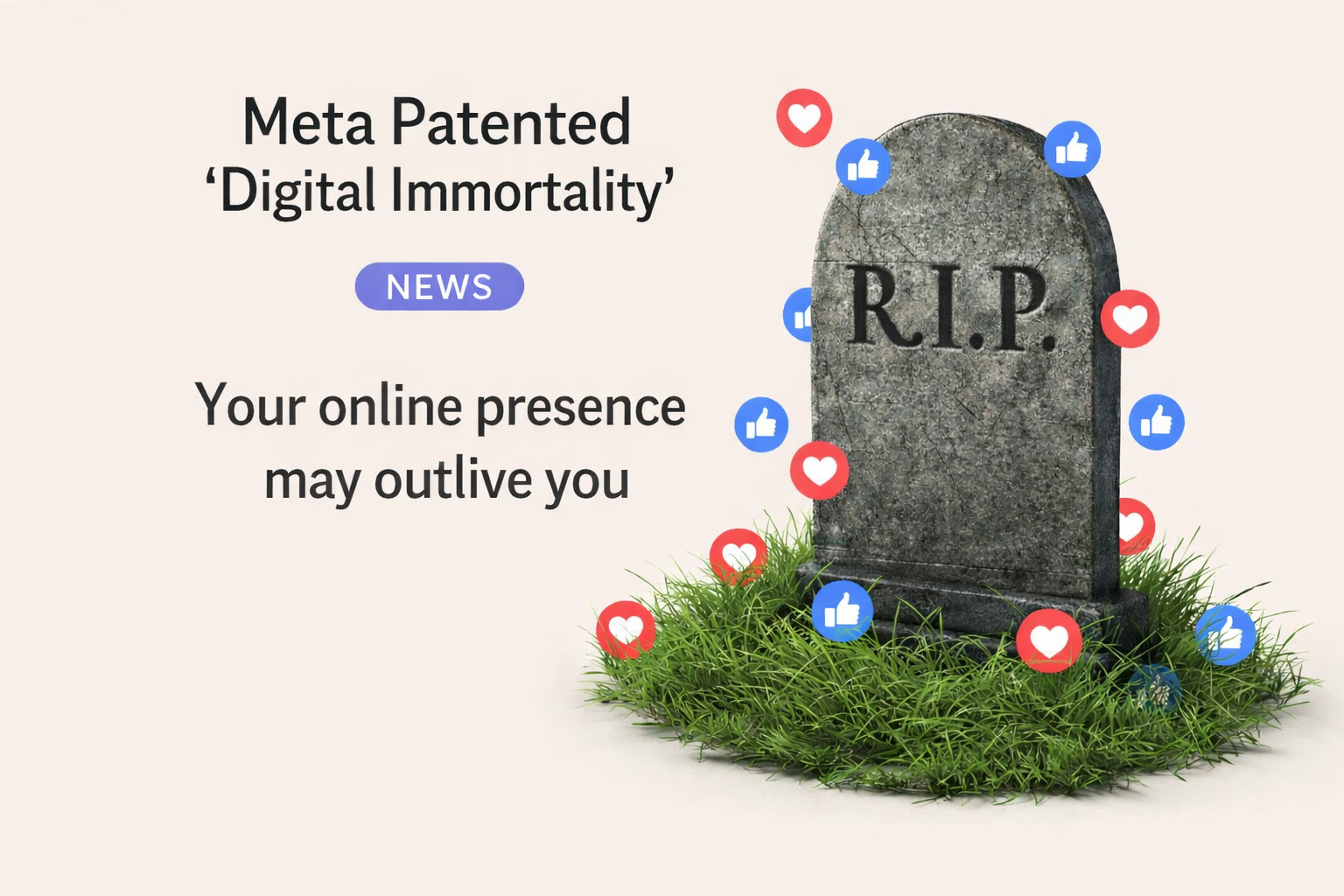
Meta Patented “Digital Immortality”.
And it’s not sci-fi — it’s where social media is heading
Why losing an Instagram account now feels like losing part of your identity
Meta Platforms recently filed/received a patent describing a system that could keep a user “active” on social media after they die.
This isn’t about a memorial page.
It’s about an AI that can analyze a person’s behavior and recreate it online — generating posts, replies, and interactions that resemble the real user.
The idea was highlighted in media coverage (including Business Insider): Meta is exploring “digital legacy” tech that goes far beyond preserving a profile.
What the patent describes (in simple terms)
The system trains on a user’s digital footprint:
- posts and captions
- comments
- private messages
- reactions/engagement patterns
- writing style and tone
- social graph (who you interact with)
After training, the algorithm could:
- reply to other people
- publish new content
- maintain conversations
- run the profile in the user’s voice
In practice, this means social platforms are starting to treat an account not as a page — but as a behavioral model of a person.
Why this changes how we should view Instagram
Instagram stopped being “an app for photos” a long time ago.
Today, an account is:
- a business asset
- a portfolio
- a customer pipeline
- years of conversations
- reputation and trust
- social identity
Meta is preparing for a world where a profile can outlive its owner.
But reality often looks like the opposite: while platforms think about “digital immortality,” users lose access to accounts every day.
The modern social media paradox
On one side:
platforms preserve your data forever.
On the other:
an algorithm can erase your access in minutes.
In real life, the second happens more often:
- automated restrictions
- false bans
- account hijacks
- lost access to email/phone
- business profiles disappearing overnight
Accounts have never been more valuable — and never harder to control.
Why bans happen even when you “did nothing wrong”
Most social networks run on anti-fraud logic.
They don’t always look for a clear violation.
They look for behavioral anomalies.
Common triggers include:
- logging in from a new device
- IP/location change
- sudden activity spikes
- mass actions (follows/DMs/likes)
- login attempts after a hack
- suspicious reports/complaints
- VPN usage in sensitive moments
The system compares your current actions with your “normal” pattern.
If it doesn’t match, it may assume it’s not you.
Sometimes, the owner ends up looking like the attacker.
Why account recovery became so hard
Before: support checked documents and basic ownership signals.
Now: platforms check the behavioral model.
It’s not only “who are you?”
It’s “do you behave like you?”
If a hijacker already interacted with the account, the “digital pattern” shifts — and the real owner can look suspicious.
Hacking today is identity theft
When an account is taken over, it’s not just a page that disappears.
What gets stolen is:
- audience
- messages
- history
- trust
- name/brand
Meta may be building tech to replicate a person after death — but right now, losing access can erase someone’s presence while they’re alive.
Where this is heading
Platforms are moving toward a new model:
account = digital person
That usually means:
- more automated checks
- more restrictions
- more false positives
- less human support
For algorithms, blocking a real user is often “safer” than letting a bad actor in.
Conclusion
Meta is preparing for a future where a profile can exist without its owner.
But today’s reality is the reverse:
a person can exist — without their profile.
That’s why losing an Instagram account is no longer a “technical issue.”
It increasingly feels like losing a piece of your digital identity.
If your account is already banned or hacked (quick note)
Instagram often verifies behavior, not documents.
Repeated login attempts and random recovery actions can make things worse — the system may flag the owner as suspicious.
In many cases, the account isn’t deleted — it’s under review.
The first hours and the order of actions matter.
If you’ve lost access, don’t “guess” fixes. Act carefully.
At unban.net, we help recover Instagram accounts after bans and hacks — when standard methods don’t work anymore.
Need Help Analyzing Your Instagram Suspension?
If your Instagram account has been suspended and you cannot pass identity verification, the specialists at Unban.net can analyze your case and help determine possible recovery options.
📩 Telegram: @IGfix
📢 Telegram Channel: @instagram_razblokirovka