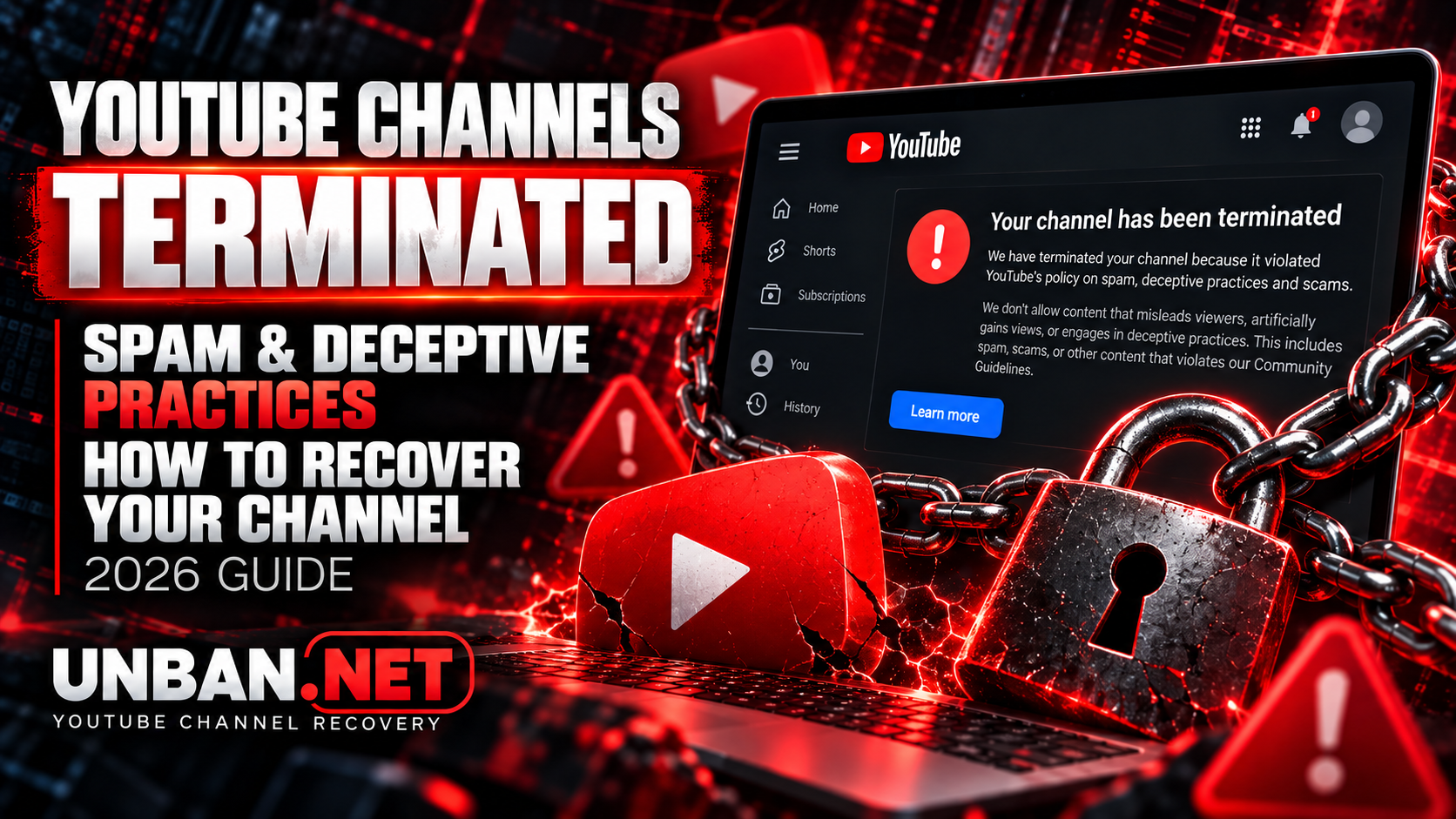
YouTube Channel Terminated for Spam, Deceptive Practices & Scams in 2026 — What to Do If Your Appeal Is Rejected
YouTube continues to terminate channels for violations of its Community Guidelines in 2026. One of the most common reasons is Spam, Deceptive Practices & Scams.
For many creators, a channel termination comes as a complete surprise. Their YouTube channel may be permanently removed without receiving three previous strikes, and their initial appeal may be rejected.
Losing a YouTube channel can mean losing years of uploaded videos, thousands of subscribers, accumulated views, and an important source of income.
However, receiving a termination notice for Spam, Deceptive Practices & Scams does not necessarily mean that the channel owner was involved in financial fraud.
YouTube's policy covers a wide range of activities, including spam, misleading content, artificial engagement, repetitive uploads, deceptive links, and other practices that may manipulate the platform.
At Unban.net, we work with account recovery requests, including YouTube channel terminations where creators have already attempted to appeal the decision.
In this article, we'll explain why YouTube terminates channels for spam and deceptive practices, how the appeal process works, and what you can do if your YouTube termination appeal has already been rejected.
More Than 2.3 Million YouTube Channels Removed for Spam and Deceptive Practices
The scale of YouTube's enforcement is significant.
According to Google's YouTube Community Guidelines Transparency Report, between April and June 2026, YouTube removed approximately 2.73 million channels for violations of its Community Guidelines.
Of those, approximately 2.31 million channels were removed under the Spam, Deceptive Practices & Scams category.
That represents about 85% of all channel removals during the reporting period.
These figures demonstrate how frequently YouTube enforces this particular policy.
However, they do not mean that all affected channels belonged to legitimate creators or that their removals were incorrect. The statistics also include channels engaged in actual spam, scams, and other prohibited behavior.
For legitimate creators who believe their channels were terminated incorrectly, the important question is whether the decision can be challenged.
What Does Spam, Deceptive Practices & Scams Mean on YouTube?
Many creators assume that a channel can only be terminated for this reason if they have deliberately scammed viewers.
In reality, YouTube's spam and deceptive practices policies are much broader.
They cover content, metadata, and activity designed to mislead users, artificially increase engagement, or exploit the platform.
Potential violations include:
- Uploading large amounts of repetitive or mass-produced content.
- Posting identical or highly similar promotional comments.
- Artificially increasing views, likes, or subscribers.
- Using misleading titles, thumbnails, or descriptions.
- Directing viewers to prohibited or harmful external websites.
- Using automated tools to generate large volumes of low-value repetitive content.
- Reuploading material from other sources without meaningful original contribution.
- Promoting fraudulent offers or misleading financial schemes.
YouTube's policies can apply to videos, Shorts, descriptions, comments, community posts, thumbnails, links, and even private or unlisted content.
This means that a channel may face enforcement related to material that the owner does not consider part of their main video content.
For example, a suspicious external link or repeated promotional activity may be relevant even if the uploaded videos themselves appear ordinary.
A termination notice does not always identify every individual action that contributed to YouTube's decision.
Can YouTube Terminate a Legitimate Channel by Mistake?
Yes. Moderation errors are possible.
YouTube uses a combination of automated systems and human reviews to identify violations of its Community Guidelines.
Automated systems can process enormous amounts of content, but they may not always interpret context correctly.
This is one reason YouTube provides an official appeals process.
However, a channel owner believing that their termination was unfair does not automatically prove that YouTube made a mistake.
Sometimes, the issue may involve activity that the creator overlooked, such as repetitive comments, externally purchased promotion, or links included in descriptions.
When reviewing a possible wrongful termination, it is important to examine the channel's actual content and activity rather than focusing only on the wording of the termination email.
Why Does YouTube Terminate Channels Without Three Strikes?
One common misconception is that YouTube must issue three Community Guidelines strikes before permanently terminating a channel.
Although three strikes within 90 days can result in termination, YouTube also allows channels to be removed for other reasons.
According to its official rules, termination may occur after:
- Repeated violations of the Community Guidelines or Terms of Service.
- A single case of severe abuse.
- Activity showing that a channel is primarily dedicated to violating a particular policy.
Severe spam can fall within these circumstances.
As a result, a YouTube channel can sometimes be terminated without receiving the usual sequence of warnings and strikes.
When this happens, YouTube generally sends an email explaining the reason for the termination and provides information about the available appeal process.
What Happens When YouTube Permanently Terminates a Channel?
A full channel termination can have serious consequences.
The owner loses access to normal channel management features, and their videos are no longer available through the terminated channel.
If the channel participates in the YouTube Partner Program, termination also ends its eligibility to earn revenue through that channel.
Depending on the circumstances, YouTube may withhold unpaid earnings.
Additionally, the platform applies its Circumvention of Channel Termination rules.
These rules prohibit terminated creators from using, creating, acquiring, or possessing other YouTube channels to bypass the termination.
The restriction can extend to existing channels and channels in which the terminated creator is repeatedly or prominently featured.
Simply creating another YouTube channel after being terminated can therefore cause additional enforcement problems.
How to Appeal a YouTube Channel Termination
If you believe that YouTube terminated your channel incorrectly, the official appeals process is the first step.
YouTube generally allows affected creators to review their termination information through YouTube Studio.
The process typically involves:
- Opening YouTube Studio.
- Reviewing the termination notice.
- Selecting the option to begin a review.
- Choosing to start an appeal.
- Providing a contact email address.
- Explaining why you believe the termination decision was incorrect.
If the appeal option is unavailable through YouTube Studio, the official YouTube Help Center provides an alternative appeal form for eligible cases.
What Should You Include in Your YouTube Appeal?
Avoid submitting an appeal that simply says:
"I didn't violate any rules. Please restore my channel."
Instead, explain the relevant facts about your channel.
Useful information may include:
- The type of content published on the channel.
- How the videos were created.
- Whether the content was original or licensed.
- How the channel was promoted.
- Whether automated tools or third-party promotion services were used.
- The purpose of any external links.
- Why the activity does not violate the policy cited in the termination notice.
You should only provide accurate information.
A well-structured appeal can help reviewers understand the context of the channel, but it does not guarantee reinstatement.
YouTube Appeal Rejected — What Can You Do Next?
This is one of the most frustrating situations for creators.
After submitting an appeal, YouTube may send an email confirming that the channel has been reviewed and that the original termination decision will remain in place.
The response may state that the channel will not be reinstated.
For creators who have spent years building their audience, this can feel like the end of their YouTube project.
However, it is important to distinguish between a rejected appeal and the possibility of a future authorized review.
An appeal rejection does not establish that every future reversal is impossible, but it does mean that YouTube has upheld the termination at that stage.
There is no guaranteed method to overturn that decision.
YouTube limits the number of termination appeals, and further submissions may not receive another substantive review.
Under its published rules, creators have up to one year from the termination date to submit an appeal.
For this reason, it is essential to understand the reason for the termination and the history of previous appeals before attempting additional action.
Why Repeated Appeals May Not Work
Sending the same appeal repeatedly does not necessarily improve the chance of success.
YouTube may issue automated responses when an appeal has already been reviewed or the applicable appeal limit has been reached.
If your appeal has been denied, consider whether there is genuinely new evidence or context that could support a review through an available authorized process.
Repeatedly submitting generic messages without addressing the alleged violation is unlikely to resolve the underlying issue.
Common Mistakes After a YouTube Channel Termination
Creators sometimes make decisions that complicate their situation after losing access to a channel.
Submitting generic appeal templates
A template may fail to address the specific category of violation or the circumstances of the affected channel.
Ignoring external links and promotional activity
The problem may involve a video description, comment, website link, or third-party promotional service rather than the video itself.
Assuming that no financial fraud means no violation
Spam and deceptive practices policies cover much more than financial scams.
Creating replacement channels to bypass termination
This may violate YouTube's circumvention rules and put additional channels at risk.
Sharing Google account passwords with unknown recovery providers
A channel termination review should not require handing over your Google password or two-factor authentication codes to an unfamiliar third party.
Be cautious of anyone promising guaranteed reinstatement or claiming to have special access to YouTube's internal systems.
Can You Recover a Terminated YouTube Channel After an Appeal Is Denied?
A terminated YouTube channel may be reinstated if the decision is overturned through an available process, but recovery is never guaranteed.
The outcome depends on several factors:
- The official reason for termination.
- The content and activity associated with the channel.
- Any previous Community Guidelines violations.
- The evidence available to support a review.
- The results of earlier appeals.
- Whether an authorized review option remains available.
It is also important to distinguish between different termination categories.
For example, Spam, Deceptive Practices & Scams is different from Harmful or Dangerous Content, Circumvention Policy, and Copyright.
Each category involves different rules and potentially different procedures.
That is why a recovery approach suitable for one terminated channel may not apply to another.
How Unban.net Helps Recover Terminated YouTube Channels
At Unban.net, we assist YouTube channel owners whose channels have been terminated for various reasons.
Many clients contact us after their own attempts to appeal the termination have been unsuccessful.
We review the circumstances of the channel termination, the official reason provided by YouTube, previous appeal responses, and any available options for further action.
When reviewing cases involving Spam, Deceptive Practices & Scams, we pay particular attention to the channel's content, publishing activity, external links, and potential grounds for reconsidering the termination.
Our goal is to determine whether there are valid grounds for recovery and what actions may be available in each specific case.
Unban.net does not require you to share your Google or YouTube account password.
We do not guarantee that every terminated channel can be restored, as the final decision remains with YouTube.
What to Do If Your YouTube Channel Has Already Been Terminated
If YouTube has terminated your channel for Spam, Deceptive Practices & Scams, don't rush to create a new channel or submit multiple identical appeals.
First, save the following information:
- The URL of your terminated YouTube channel.
- The official termination email explaining the reason for removal.
- The date your channel was terminated.
- The text of any appeal you have already submitted.
- YouTube's response to your appeal.
- Information about your channel's content and external links that may have contributed to the decision.
These details can help identify the reason for the termination and determine possible next steps.
If your initial appeal has already been rejected, it is especially important to carefully assess the situation before taking further action.
Need Help Recovering Your YouTube Channel?
If YouTube has permanently terminated your channel for Spam, Deceptive Practices & Scams and your standard appeal was unsuccessful, you can contact Unban.net for assistance.
We help channel owners understand the reasons behind YouTube terminations and explore available recovery options.
When contacting us, please provide your channel URL and a screenshot of the official YouTube termination email.
Unban.net — YouTube Channel Recovery & Instagram Account Recovery.